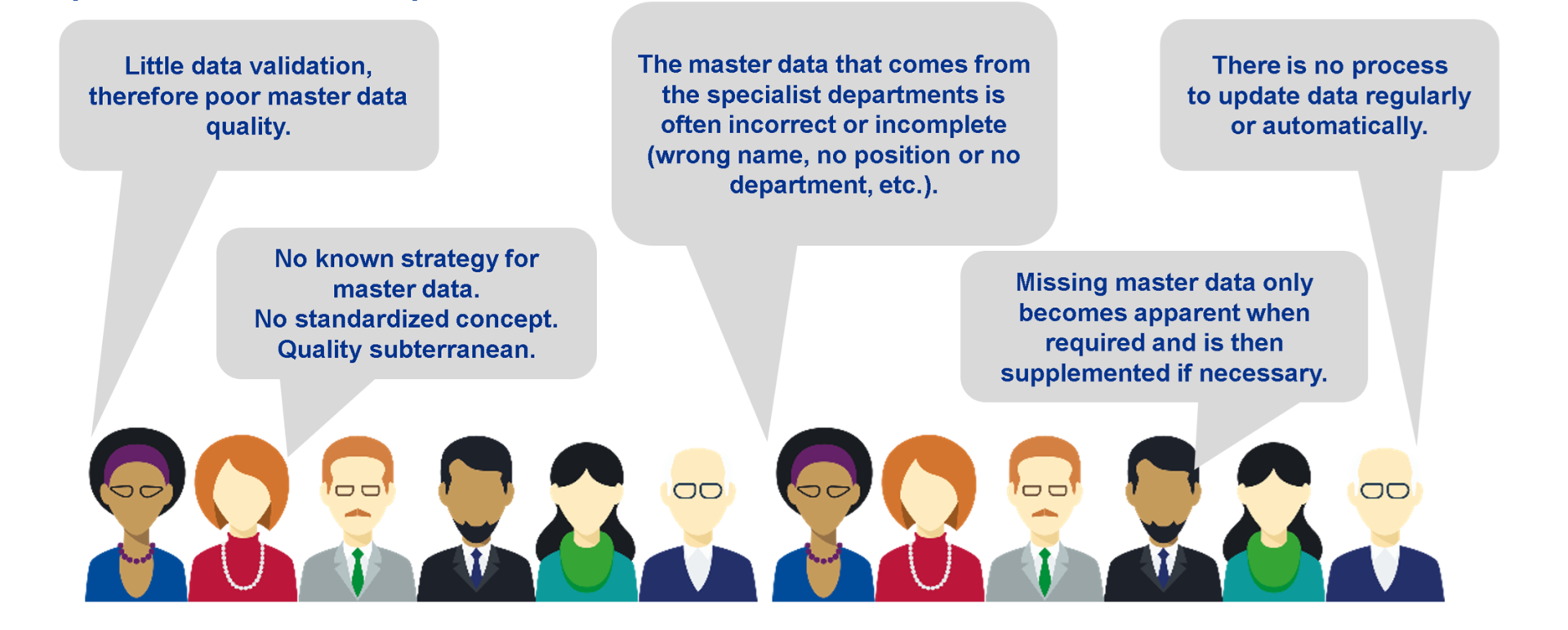
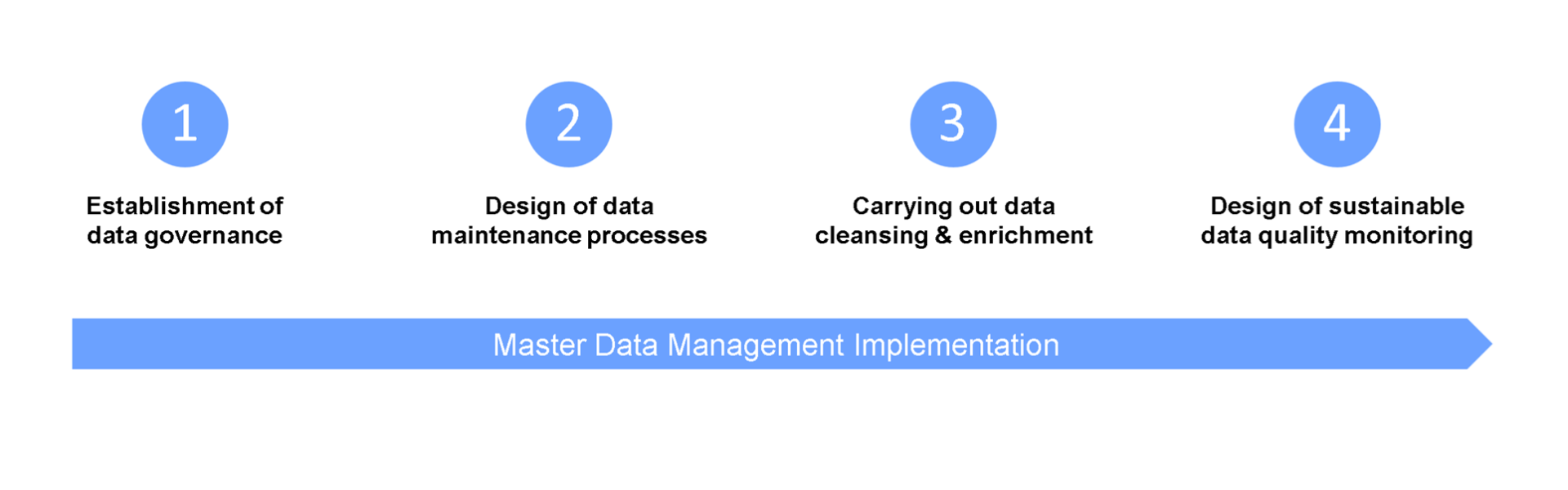
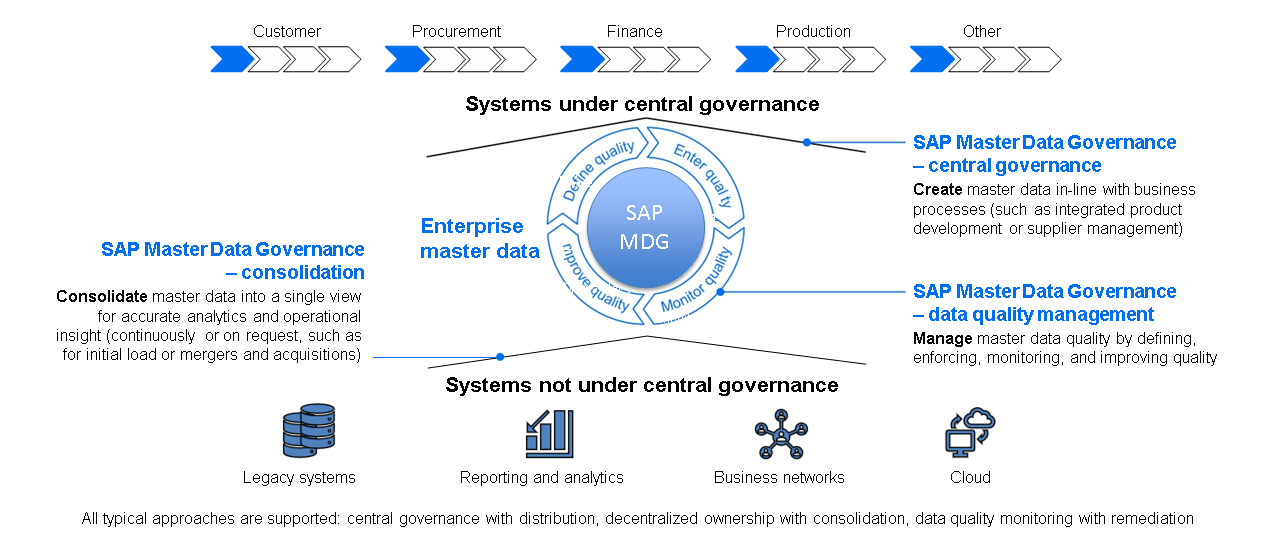
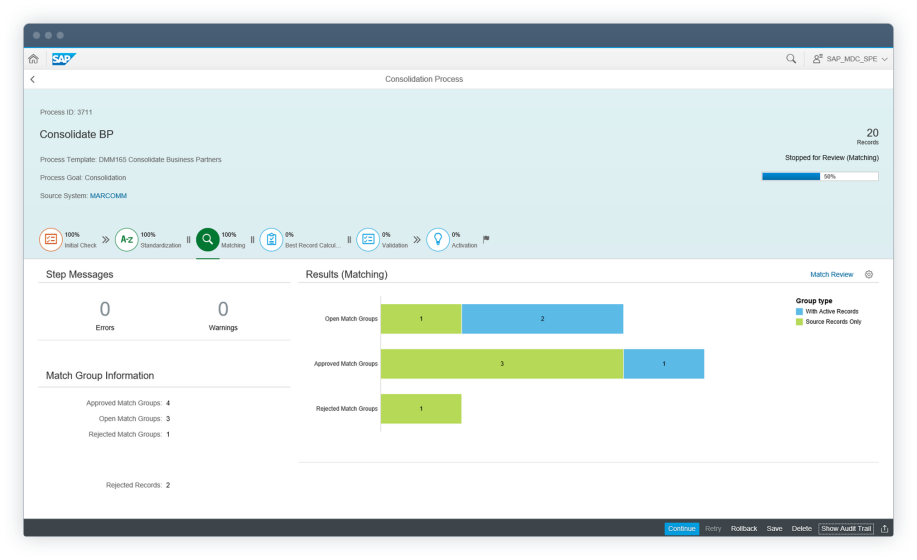
Today's companies typically use multiple applications and systems such as ERP, HCM, and CRM, which are used differently depending on the department. Due to the large number of users accessing the data in these systems, it's common for the data to be isolated, duplicated, outdated, or even contradictory. And everyone knows that bad data leads to bad decisions. To meet the changing information needs and the simultaneously increasing number of data sources, companies are implementing master data management solutions.
Master data is all data that is critical to the functioning of a company. It describes people (customers, employees, and suppliers), places (offices and locations), and things (products and facilities). Master data typically represents only a small percentage of all company data, but it is among the most complex—and valuable—data in a company.
Customer master data: As the name suggests, customer master data includes all the core data required to do business with your customers—from contact information to purchase history and payment terms. Managing master data in this area involves cleansing and standardizing data across ERP, CRM, and other systems. For example, the same customer's name and address may exist in both an ERP and CRM system but be entered in two different ways, such as Platanenstr. 13 or Platanenstraße 13. MDM reconciles these differences and creates a unified view of each customer, which can be used to personalize marketing campaigns or improve the customer experience, among other things. In some companies, customer master data also includes employee, patient, and vendor data.
Vendor master data: Vendor master data includes data on vendor accounts, contracts, policies, pricing, and more. They are at the heart of all key procurement activities, from planning and procurement to contract awarding and purchasing. Clean and trustworthy supplier master data is important for answering questions about supplier spending, pricing, or performance, for example.
Location master data: A company's location data contains key attributes related to the physical locations of agencies, corporate offices, distribution centers, and stores. By linking this information with other data domains, this information can support location-based decision-making, for example, when determining the right product assortment for a specific store.
Product master data: Managing product master data includes attributes such as product number, category, price, features, bills of materials, and all other required data points. This data is used across processes for sales, marketing, logistics, and the product development lifecycle and must therefore be reliable and accurate.
Asset master data: Asset master data describes a company's tangible and intangible assets, such as inventory, equipment, and brands. They typically contain attributes such as depreciation terms and values, asset categories, and leasing information. If the asset master data is inaccurate or incorrect, the assets cannot be adequately utilized and managed. For example, incorrect master data could lead to incorrect forecasts in predictive maintenance.
In addition to supporting companies in decision-making and answering key questions, master data management offers a number of other benefits, including:
Reduction of errors and redundancies in data across different applications. When different teams inconsistently enter the same information, such as a customer record, MDM consolidates and reconciles duplicate data.
Improved analytical insights and data-driven decisions. Useful results require useful inputs. If the data being analyzed is faulty, the results may also be inaccurate.
Business processes are optimized and efficiency is increased. End-to-end business scenarios such as lead-to-cash, source-to-pay, and design-to-operate can be accelerated and automated with high-quality, consistent master data.
Increased transparency and compliance with data protection and other regulations. One example of this is the GDPR, which gives people greater control over the collection, management, and sharing of their data. Without MDM, data records can be scattered across departmental silos, making compliance difficult.
Mergers and acquisitions can be assisted by an improved process for integrating and reconciling multiple data sets.
Data plays a critical role in digital business processes, and master data is the foundation for all other data. Companies that rely on accurate and consistent master data have a solid foundation for their success.
Fewer errors and redundancies in data across applications. When the same information, such as a customer record, is entered inconsistently by different teams, MDM consolidates and reconciles the duplicate data.
Better analytical insights and data-driven decisions. Useful results require useful inputs. If the data being analyzed is incorrect, then neither will the results be.
Optimized business processes and increased efficiency. With high-quality, consistent master data, you can accelerate and automate end-to-end business scenarios such as lead-to-cash, source-to-pay, and design-to-operate.
Improved transparency and compliance with data protection and other regulations. The GDPR, for example, gives people more control over how their data is collected, managed, and shared. Without MDM, data records can be scattered across multiple departmental silos, making compliance difficult.
Support for mergers and acquisitions with an optimized process for merging and reconciling multiple data sets.

 en
en  de
de